Healthcare & Clinical Practice

See how recovery is actually unfolding, not just how it looks at the surface.

Your Brain's Vital Sign.

Track recovery across sessions so decisions about progression, pacing, and return to daily life are grounded in more than milestones and observation.

THE CHALLENGE

In clinical recovery, progress can be real and still feel uncertain.

Patients may regain strength, symptoms may improve, and milestones may appear to be met, yet real-world function like balance, coordination, and multitasking can still lag behind. The challenge is not effort, but accurately understanding what is truly changing and when adjustments are needed.
Recovery is rarely linear. What looks like progress in clinical measures may not fully reflect functional readiness in everyday demands, making timing and decisions more complex for care teams.
Clinical Observation
Patient Self-Report
Functional Milestones
Beneath The Surface

What you can't see matters.

Recovery doesn't break down only at the level we can observe.

Beneath visible movement and reported symptoms, the brain is continuously adapting, a; stabilizing, compensating, and reorganizing how it supports coordination, timing, and control.

Patients can appear ready at the surface while performance is still evolving underneath.

This is where uncertainty lives; and where better visibility matters most.

See Decline Before Its Visible

When recovery is visible over time, it shifts from a snapshot to a direction.

PAST INTERVENTIONS
Unclear
Missed
Uncertain
Felt
WITH NERON
Clearer trajectories
Earlier plateau detection
More confident pacing decisions
Recognized and communicable progress

This isn't about replacing staff expertise.
It's about reducing unknowns in the highest-stakes moments.

WHY THIS MATTERS FOR SPORTS PERFORMANCE

Are the demands we're placing on this athlete aligned with what their performance can actually support right now?

When brain performance is more stable, it supports faster decisions, cleaner execution, and consistent control under pressure. When that margin narrows, performance may still look strong in controlled settings — but becomes less reliable as speed, fatigue, or complexity increase.

These shifts don't define the athlete. They reveal how performance is responding to current conditions — which can change with workload, fatigue, recovery, and environment — and where risk begins to surface.
FOR PERFORMANCE DIRECTORS & SPORTS SCIENCE TEAMS  
Objective support for decisions about training load, recovery timing, and competitive readiness.
FOR ATHLETIC TRAINERS & MEDICAL STAFF  
Context for return-to-play conversations that goes beyond symptom resolution and self-report.
FOR COACHES BALANCING READINESS WITH RISK
A signal for when the athlete's brain is aligned with what the session or competition demands.
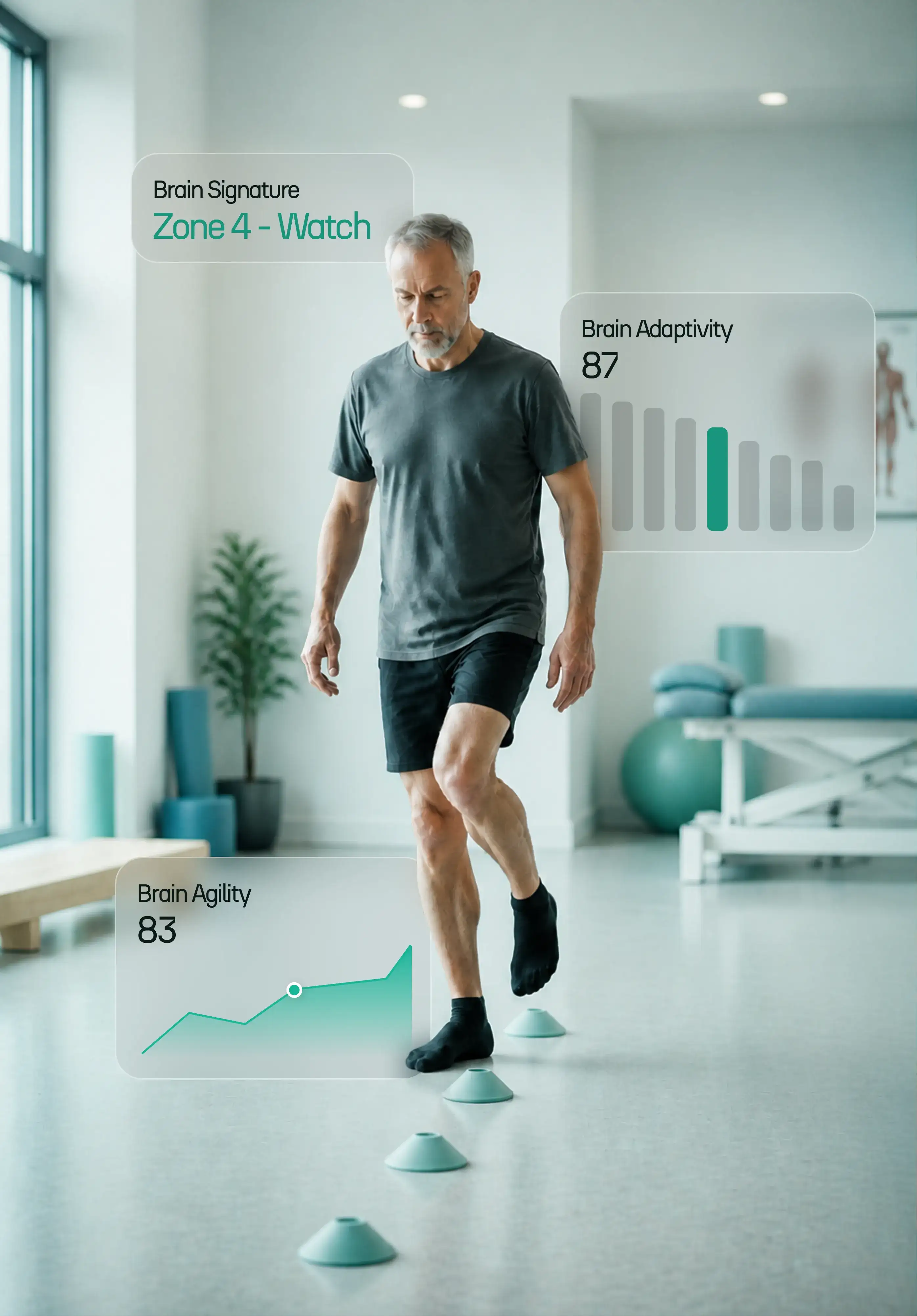
Brain Adaptivity
75
Brain Signature
Zone 5 - Optimal
Brain Agility
94
Why This Matters For Clinical Practice

What can this person confidently handle right now, and where might they still benefit from time, support, or progression?

Beneath visible movement and reported symptoms, the brain is continuously adapting. Patients can appear ready at the surface while performance is still evolving underneath.

NERON tracks recovery across sessions; not just isolated checkpoints; helping clinicians see where performance is stabilizing and where it is still adapting. This shifts the conversation away from pass/fail thinking toward something more useful: what a patient can confidently handle right now, and where the trajectory is heading.
FOR REHABILITATION CLINICIANS & CARE TEAMS
Longitudinal visibility into control and adaptation, not just symptom status or milestone completion.
FOR RETURN-TO-FUNCTION PROGRAMS
Objective context for return-to-work, school, or daily-life decisions that goes beyond what patients report.
FOR PATIENTS
Progress made visible, even when it isn't obvious yet — so recovery feels less uncertain and more directed.
HOW TO READ IT

Brain Signature: Recovery in Context

As recovery becomes clearer over time, something else begins to take shape:
what a patient's current level of performance can realistically support in daily life.
Not a single checkpoint but a direction.

IdeaL neuromotor control
Consistent control across a wider range of real-world situations, supporting confident return to daily activity.
Compromised neuromotor control
Patients may still be improving, but show less consistency as demands increase, a stage that benefits from continued support or careful pacing.

What matters is not a single checkpoint. It's understanding how well performance is supporting return-to-life demands today — and how that support is strengthening over time.

HOW IT’S USED

Bring continuity to recovery across every session, not just checkpoints.

NERON is used to:
Track recovery across sessions to see trajectories, not isolated snapshots
Identify plateaus or variability early, before they compound
Support return-to-work conversations with objective context beyond self-report
Reinforce safety culture with measurable insight, not blame
Track functional readiness across an aging workforce — proactively, not reactively
WHO THIS IS FOR
  • Rehabilitation clinicians and care teams
  • Practices supporting return-to-function decisions
  • Programs focused on functional progression over time
  • Teams seeking stronger patient communication and confidence
Longitudinal Tracking
Follow recovery across sessions not just isolated assessments
Plateau Detection
Identify when progress is stalling before it becomes a clinical concern
Pacing Support
Make treatment progression decisions with objective context
Patient Communication
Show patients progress that may not yet feel obvious to them
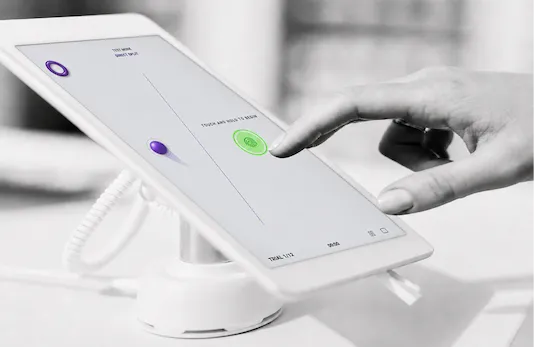
Individuals use a tablet to guide movement toward simple on‑screen targets.